Behind Every Number Is a Young Person Hoping Someone Notices:
Insight to 2025 Pennsylvania Youth Survey (PAYS)
What if an empty desk told a bigger story?
The Latest Pennsylvania Youth Survey offers encouraging signs of progress, but it also reminds us that thousands of Lancaster County youth are still carrying invisible struggles. Here’s what those numbers really mean-and how every adult in our community can improve the circumstances in which we all live and learn…
Walk into any classroom in Lancaster County.
You might notice students laughing with friends, finishing assignments, checking their phones before class begins, or talking about their plans after graduation.
What you won’t immediately see are the invisible battles some of them carry, like:
The student wondering, am I good enough?…
The student who hasn’t slept well in weeks…
The teenager who is smiling, but feels completely alone.
Then there is the young person quietly hoping that someone would just ask… “how are YOU really doing today?”
Every two years, thousands of Lancaster County students anonymously answer the Pennsylvania Youth Survey (PAYS). Their responses provide us with something incredibly valuable-not just data and numbers, but a glimpse into what it feels like growing up in our local community today.
So with the release of the 2025 PAYs DATA Survey, we introduce the data.
For starters, there is encouraging news.
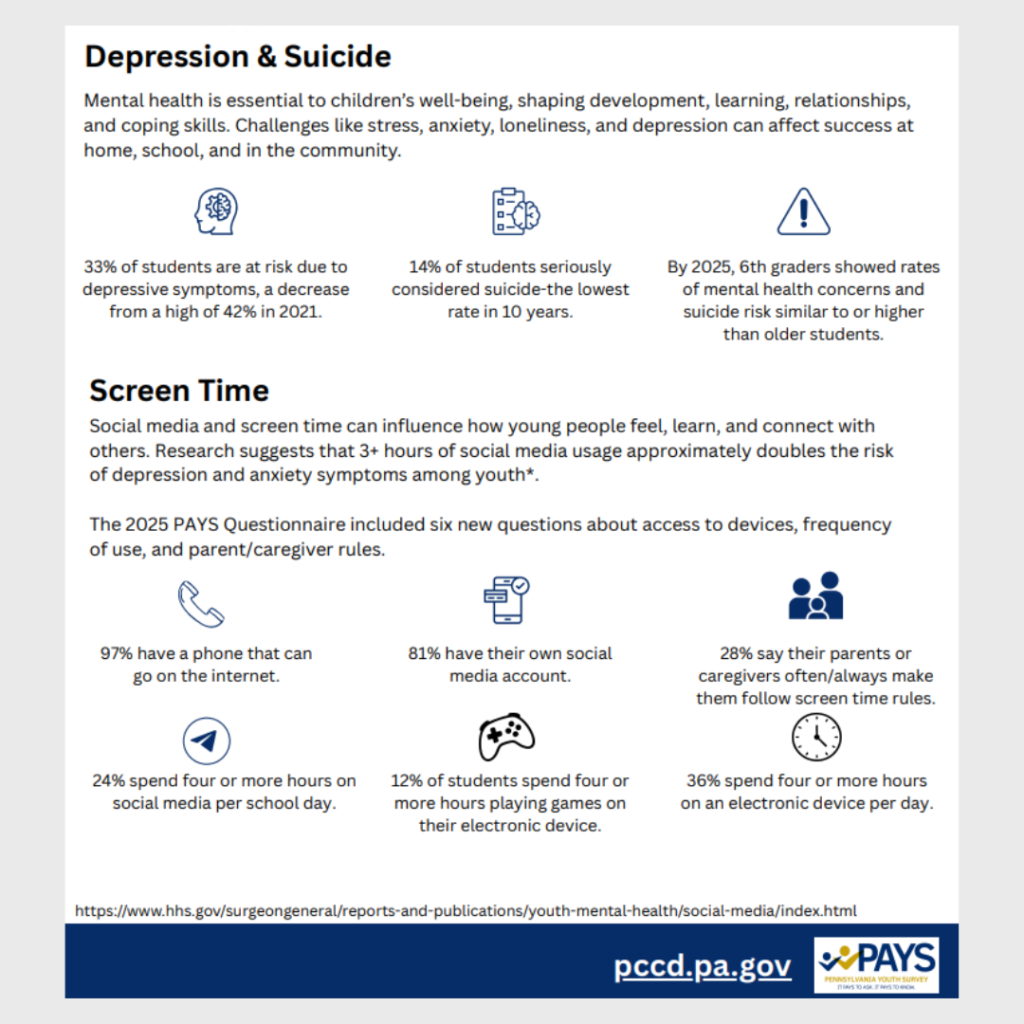
Compared to previous years, more Lancaster County students report positive mental health, and the indicators of depression and suicidal thoughts among older students is moving in the right direction towards improvement.
These improvements are starting to reflect years of investment from family, educators, healthcare providers, schools, non-profits, community organizations, and peer advocates working together to make youth mental wellness a priority here in Lancaster County, and the state of Pennsylvania.
We are excited to see this progress, but it should not allow us to become complacent. Why?
Well, now imagine a classroom of 30 senior high school students, who during the survey have admitted that their mental health has not been good over the past month.
Eight people who interact daily and sit next to one another.
Eight different stories.
Also, eight opportunities for someone to notice.
When one-third of a classroom, a classroom that will be heading out into their unknown journey into the future next, shows that they sometimes believe that they are “no good at all,” we must remember this not as just a percentage but that;
It could be the student who stopped raising their hand.
The athlete who suddenly quit the team.
The teenager who tells everyone they are just “fine”.
Or maybe that child who is starting to believe their future is not worth investing in.
These are not numbers; they are not strangers.
They are our children, our neighbors, our classmates.
They will be our future workforce, our future parents, and future community leaders.
Hope lives in relationships. One of the most encouraging findings from this year’s survey is that more students are turning to peers, parents, and caregivers when they need help.
This concludes something powerful…healthy relationships matter…conversations matter…trust matters, and this saves lives.
Every meaningful connection becomes another protective factor that helps our young people navigate all of life’s challenges.
This is exactly why Touchstone Foundation invests not only in supporting access to therapy, but also in strengthening the people and systems that surround our youth every day, through the support of parents, educators, mentors and trusted community partners.
So, what does this mean for Lancaster County?
Parents – your conversations and check-ins matter so much more than you might realize.
Teachers- Sometimes the most important lesson isn’t taught from a textbook-it’s helping a student feel seen.
School Counselors and Social Workers- You are the bridge between struggle and support.
Coaches- You teach resilience long before the scoreboard matters.
Community Partners- every youth program you create provides that safe space where belonging can grow.
Mental Health Systems- Dedication to newly licensed clinicians mean more families can receive care sooner.
Student Leaders- When you choose kindness, include peers who are feeling isolated, or encourage a friend to seek help, you change culture.
Donors- Your generosity fuels opportunities and a ripple in Lancaster County to secure spaces and programming where young people know they are valued and keep our mission going.
Helping parents navigate technology, encouraging healthy boundaries, strengthening communication, and creating opportunities for meaningful face-to-face connection are all part of building lifelong mental wellness. When families feel equipped to guide young people through an increasingly digital world, children are better positioned to thrive both online and offline.
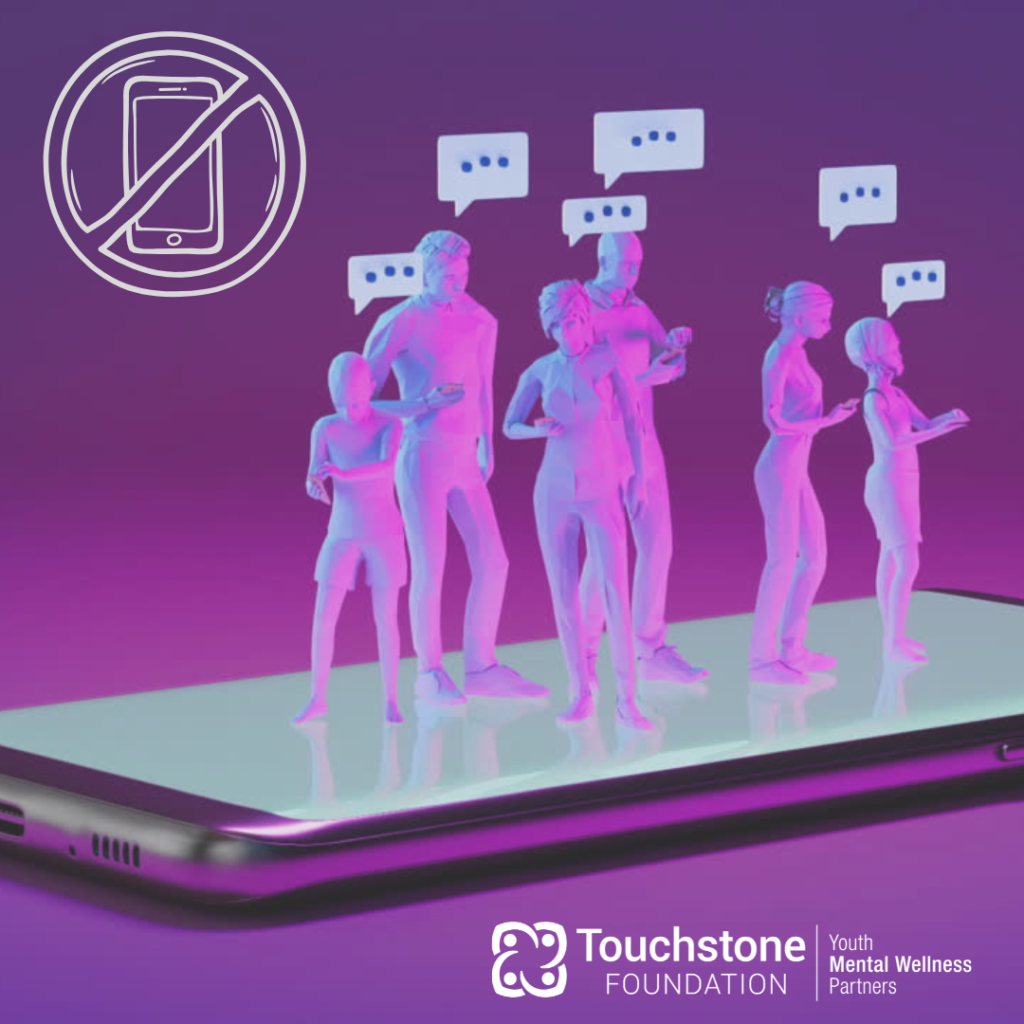
New to this year’s survey was adding an inquiry about how social media and screen time can influence how young people feel, learn, and connect with others.
Today’s young people are growing up with access to the internet in their pockets. Technology offers incredible opportunities to learn, create, and communicate, helping us stay connected. It can also help young people discover new interests, maintain friendships, and access valuable mental health resources when used intentionally.
The 2025 PA Youth survey’s inquiry about technology presence in young people’s lives reminds us that balance matters.
When Lancaster County students were asked about screen time, social media, and the boundaries surrounding technology use at home, the responses painted a picture of a generation that is more connected digitally than ever before.
By sixth grade, more than 70% of students already have an internet-connected phone. By twelfth grade, that number climbs to 97.1%, following that nearly half of sixth graders have a social media account, and by senior year almost nine out of ten students are active on social media.
This also shows that students are spending significant portions of their day online. Nearly one in four 12th-grade students spend four or more hours each day on social media or using electronic devices. Across all grades, most students report spending two to four hours or more each school day using electronic devices. Gaming is also a regular part of many students’ routines, with most reporting anywhere from two hours to three hours of gaming each day.
Technology itself is not the problem- it is the balance that will ensure that digital connection never replaces the relationships young people need the most.
No algorithm can replace trusted conversations, or genuine understanding and no amount of followers can replace knowing there is a trusted human to listen to you without judgement.
This survey also highlights opportunities for families to help build proper digital habits, where nearly one-third of students report that they have never been given rules or boundaries regarding screen time at home. Only around 16% noted that screen time is always enforced at home. This reminds us all to check in on our habits and make sure to adapt to healthy ones regarding digital habits.
For the first time, Pennsylvania introduced a pilot version of the survey designed specifically for fourth-grade students, recognizing that emotional well-being deserves attention long before children reach middle or high school. Using age-appropriate language and an optional read-aloud feature, younger students were given the opportunity to share how they are feeling in ways that match their stage of development.
The results remind us that emotions like sadness, loneliness, and worry are already part of many children’s lives. While it is normal for every child to experience difficult feelings from time to time, these early conversations help us better understand when children may need additional support, connection, or reassurance. They also reinforce an important truth: mental wellness begins long before a crisis, and so should our conversations.
Today’s families are raising children in a world unlike any previous generation has experienced. Technology is evolving rapidly. Social media continues to shape childhood and adolescence in new ways. Parents, caregivers, educators, and mentors are navigating challenges that often have no instruction manual.
That can feel overwhelming—but it also reminds us that no one is expected to have all the answers.
What matters most is that we continue learning together, asking questions together, and creating spaces where children know they are safe to talk about what they’re feeling. Every conversation around the dinner table, every teacher who notices a student having a difficult day, every coach who checks in after practice, every trusted adult who listens without judgment becomes part of a stronger network of support.
At Touchstone Foundation, we believe youth mental wellness is a community responsibility. It is built through partnerships between families, schools, healthcare providers, community organizations, and young people themselves. Together, we can help children develop healthy relationships with technology, build resilience through life’s challenges, and remind every young person that they never have to face those challenges alone.
The data tells us where we are today. Our community determines where we go next.
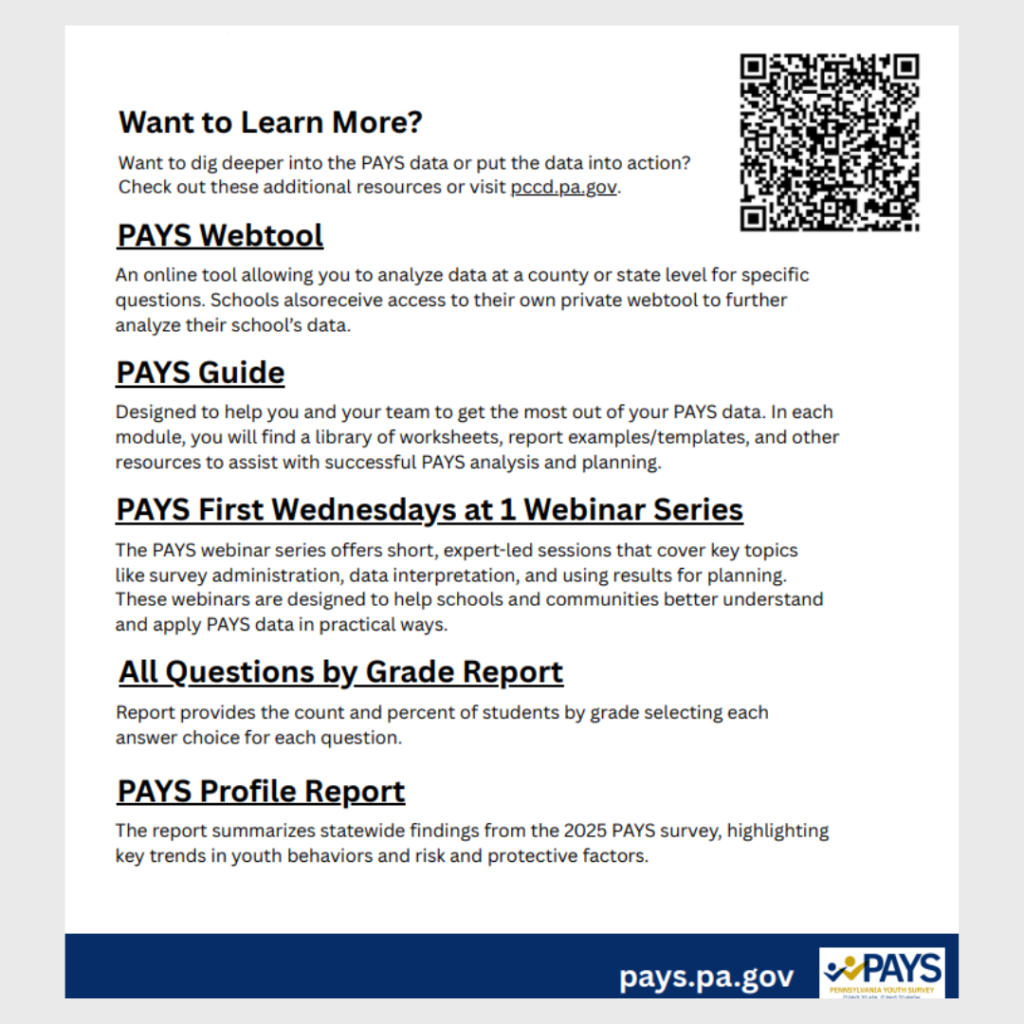
To gain more insight to this survey in Lancaster and other counties, visit: https://www.pa.gov/agencies/pccd/programs-and-services/juvenile-justice-and-delinquency-prevention/pays
To learn more about our work in schools to hold more conversations in safe spaces about mental health with the release of our Rise Above Curriculum in Lancaster County High Schools and our future extensions thanks for VIP Grant Funding, read more in our latest blog: https://touchstonefound.org/in-the-press-new-grant-funding-2026riseabove/
If you are interested in bringing Rise Above to your school, or become a facilitator in our upcoming program roll outs contact Programs Manager Madeline Mitchell mmitchell@toucstonefound.org.