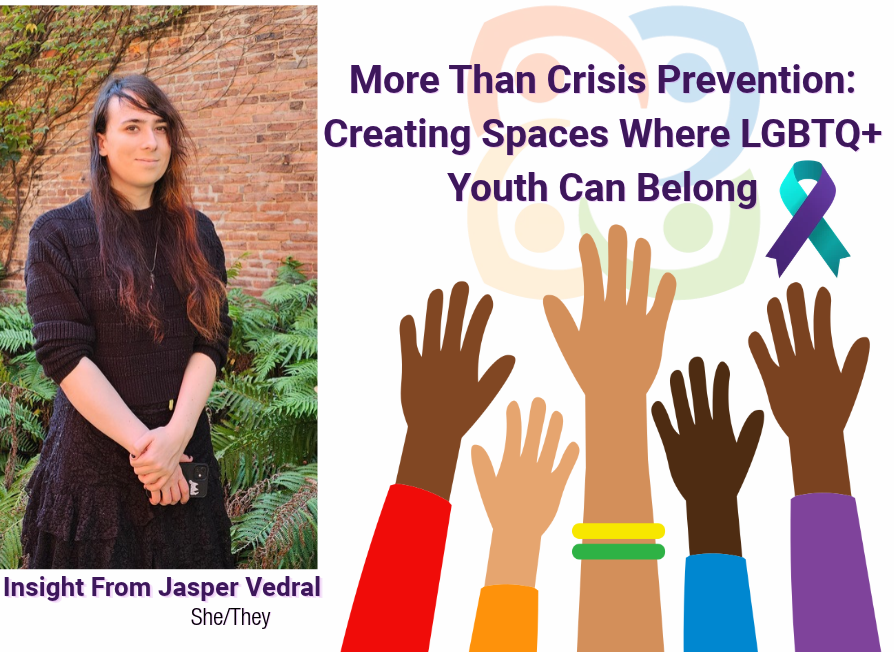
More Than Crisis Prevention: Creating Spaces Where LGBTQ+ Youth Can Belong
Content note: This blog discusses suicide, suicidal thoughts, discrimination, and mental health.
Talking about suicide prevention is extremely important to me as a trans woman.
I have known people in my community whose lives were taken too soon. I’ve had friends I’ve partied and laughed with friends who I can never see again. In the online circles I frequent, I have seen posts from fellow trans women expressing apathy toward their lives or feeling like they will never be able to “pass” as a woman because they started their transition too late.
These are heavy experiences to talk about. But silence and stigma can make an already difficult experience even more isolating.
I know because the challenges of growing up LGBTQ+ have pushed me into dark places mentally. Even now, as I transition and become more comfortable living as myself, I still experience challenges.
When You Don’t Feel Like You Belong
I remember telling a friend in early high school that I felt like a girl.
Their response was, “Then why do you have facial hair?”
I didn’t have an answer.
So I took back what I had said. I acted like I didn’t mean it. I talked about it as though it were just some weird phase.
At the time, I was also reading things online telling me that being trans, gay, lesbian, or generally queer was “just a phase.”
There were openly trans students at my high school whom I thought were incredibly brave. I wanted to be like them. I wanted to be brave, too.
But I was afraid I wouldn’t be respected. After my friend’s response, I worried that people wouldn’t take me seriously.
Even though there was an LGBTQ+ club at my school, I didn’t feel like I fit in there either. I didn’t feel like I had a space where I could safely figure out who I was.
So, for the rest of high school, I wasn’t Jasper.
I repressed those feelings, and I absolutely hated it. No matter what group I was in, I felt like I never belonged.
That’s what stigma and silence can do. They can make someone feel like hiding is safer than being seen.
When Your Identity Feels Like a Debate
That feeling doesn’t necessarily disappear when you leave high school.
I can turn on the news and hear my identity discussed as a talking point. I hear debates about whether trans people should be able to participate in sports, access certain spaces, or receive particular types of care.
But behind these conversations are actual people.
Can you imagine how unwelcome it can feel to finally tell someone who you are, only to hear, “Actually, you’re not”?
Now imagine hearing versions of that message over and over again.
When people are repeatedly made to feel that who they are needs to be explained, justified, or defended, how comfortable will they feel saying something when they are struggling?
What You Don’t Always See
There is no single transgender experience. I can only tell you what mine looks like.
Navigating an ordinary day can require more thought than someone looking at me might realize.
The effort I put into feeling comfortable with myself goes beyond receiving hormone replacement therapy. I may shave my face several times a day with an electric razor because it helps me feel more feminine. Then I apply foundation and concealer to hide the facial features I’m insecure about, hoping nobody else notices them.
I think about what I wear depending on where I’m going.
If I’m going somewhere with friends where I feel comfortable, I love wearing long black skirts or dresses. But if I’m going somewhere unfamiliar or somewhere I don’t feel safe, I may present differently because I don’t know how people will react.
Even when I present femininely, a stare or look can make me wonder whether someone is judging me.
Then anxiety starts telling me I’m not “trying hard enough.”
Does my voice sound feminine enough? Do I “pass”? What does this person think about me?
Sometimes it feels like I have to prove to the world that I am who I say I am—as if I owe everyone else an explanation for my identity.
I don’t.
Asking for Help Isn’t Always Simple
I have seen too many people in my community never receive the preventive care they need. I’ve known people who have felt that somehow it was already “too late” for them.
Even when mental health resources are available, barriers can remain.
I knew someone who wanted to begin transitioning but worried that her family would find out through their insurance. Cost can create another barrier. And finding a professional doesn’t automatically mean someone will feel comfortable opening up to them.
A young person might still be wondering:
Will this person understand me?
Will they judge me?
Will they respect my identity?
Is it safe to tell them what I’m really feeling?
If we want young people to reach out when they’re struggling, then we also have a responsibility to create environments where reaching out feels safe.
So, What Does Prevention Look Like Before a Crisis?
Suicide prevention is often discussed in the context of what to do when someone reaches a crisis.
That response is critically important.
But I think we also need to talk about what happens before that moment.
Prevention can look like creating places where young people belong. It can mean reducing stigma, building trusted relationships, making mental health care easier to access, and giving someone opportunities to talk openly before they feel like they have nowhere else to turn.
Sometimes prevention starts with something that seems small.
It looks like using someone’s name and pronouns.
It’s a parent listening before reacting.
It’s a school making sure students know which adults and resources they can trust.
It’s a friend checking in when someone doesn’t seem like themselves.
It’s creating spaces where LGBTQ+ young people don’t have to wonder whether they are welcome.
Personally, whenever I see a trans flag displayed somewhere, I feel a little more comfortable. It’s a small signal that tells me, maybe I’m safe here.
And the people who have made the biggest difference in my life didn’t need to make grand gestures.
My friends in college accepted me for who I was. They taught me how to do makeup. They cut my bangs. They included me.
Most importantly, they made me feel comfortable being myself.
You Don’t Have to Be a Mental Health Professional to Make a Difference
Raising awareness means more than speaking about LGBTQ+ mental health once in a while.
It means not participating in jokes or conversations that make someone else feel unsafe.
It means checking in when someone seems withdrawn.
It means taking someone seriously when they say they’re struggling.
It means being willing to learn instead of expecting LGBTQ+ people to constantly educate you.
And it means creating environments—in classrooms, families, workplaces, friend groups, and communities—where young people can express themselves without immediately expecting judgment or correction.
You don’t have to become a mental health professional to contribute to that environment.
My friends certainly weren’t mental health professionals.
They were simply my friends.
They made me feel welcomed and affirmed for who I was, and that made an enormous difference for my mental health.
All of us can contribute to creating communities where asking for help feels a little easier.
Choosing to Live as Myself
Before I started transitioning, the possibility that I might not receive the treatment I needed terrified me. There were moments when I wasn’t sure I wanted to live if I couldn’t become the person I knew myself to be.
I didn’t know how long I could wait.
And I know I’m not the only person who has experienced feelings like that.
There are still days when I wish being trans weren’t so difficult.
But I also know that living as someone I didn’t feel comfortable being was painful.
It wasn’t me.
And after all, who am I to deny my own happiness?
Despite the hardships and anxiety, I want to live authentically as myself.
Today, I have found people and places where I can do that.
I have friends who love me. I have family who support me. I have a community where I can confide in people during difficult moments. I have professionals I can talk to openly about my struggles.
Those connections matter.
More Than Surviving
Suicide prevention isn’t just about helping young people survive a crisis.
It’s about helping create communities where young people have the opportunity to belong, experience joy, build relationships, imagine their futures, and live authentically as themselves.
If we can create stronger connections, reduce stigma, improve access to care, and make it safer for young people to reach out, then I believe we can build a future where LGBTQ+ youth don’t have to feel ashamed of who they are before they can ask for help.
And to any trans or LGBTQ+ young person reading this who is struggling:
You are loved. You are seen. You are cared for.
There are people and resources that can help you through difficult moments. There are communities where you can be yourself and people who will welcome you with open arms.
You are not alone.
And maybe that’s where prevention begins: making it easier for someone to say, “I’m struggling,” and making sure someone is there to respond, “I’m here. Let’s find support together.”
You Are Not Alone: Support Is Available
Learn more about Jasper and their interests at Touchstone Foundation: HERE
If you are a member of the LGBTQIA+ community and looking to begin therapy, please contact us for access to our LGBTQIA+ Affirming Care Provider Directory, contact Anna Kennedy at akennedy@touchstonefound.org
If you or someone you know is struggling with mental health, experiencing suicidal thoughts, or simply needs someone to talk to, support is available. Reaching out can be difficult, but you do not have to navigate a difficult moment alone.
The Trevor Project
Provides crisis support, information, and resources specifically for LGBTQ+ young people, including opportunities to connect with trained crisis counselors.
Visit: thetrevorproject.org
It Gets Better
Provides stories, educational resources, and community support designed to uplift and empower LGBTQ+ youth and help young people know they are not alone.
Visit: itgetsbetter.org
988 Suicide & Crisis Lifeline “PRESS 3” for LGBTQ Youth Support!
If you or someone you know is experiencing emotional distress, a mental health crisis, or thoughts of suicide, call or text 988 to connect with a trained crisis counselor in the United States.
If there is an immediate threat to someone’s life or safety, call 911 or seek emergency medical assistance.