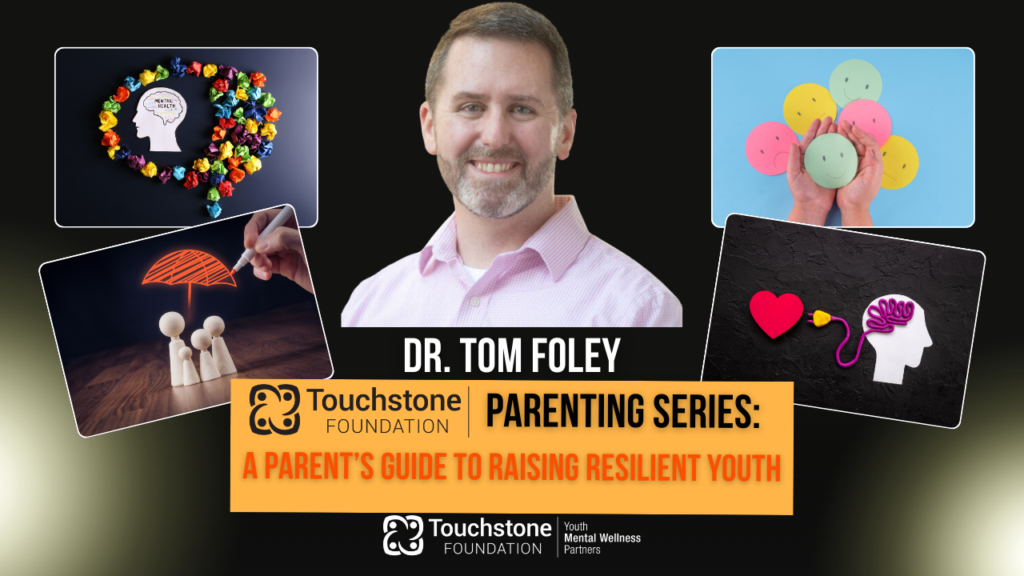
Touchstone Foundation Parenting Series: A Parent’s Guide to Raising Resilient Youth Featuring Dr. Thomas Foley
This NEW Touchstone Foundation Parenting Series is a FREE, parent-focused live discussion series designed to provide clear, hopeful, and evidence-informed guidance on children’s mental health and family resilience. Rooted in Touchstone Foundation’s mission to elevate youth mental well-being in Lancaster County, the series brings together trusted clinicians, community partners, and educators to help parents navigate today’s mental health landscape with confidence and compassion.
Each live conversation cuts through the noise of conflicting parenting advice and centers practical tools families can use at home—while reinforcing that parents are not alone and that support is available through local, trusted resources. This series is designed for parents and caregivers of children across all developmental stages who are seeking grounded guidance that is compassionate, realistic, and supportive—rather than alarmist or prescriptive.
The first episode of this series will launch on Wednesday, February 18 at 7:00 PM via a Teams Town Hall meeting link. For those unable to attend live, each episode will be recorded and archived on our YouTube channel and website for on-demand viewing. Register for the Live Link HERE
Topics We’ll Explore in the Series
Throughout this conversation, Dr. Foley shares insight on key questions many parents are carrying right now, including:
Introduction: Understanding Youth Mental Health Today (Feb18)
We begin by examining the current mental and emotional landscape facing children and teens, including what has changed over the past five to ten years and what parents are noticing at home, in schools, and in their communities.
The Science of Hope and Resilience (March18)
Hope is more than a feeling—it’s a protective factor. This series will explore how hope, connection, and supportive relationships can strengthen resilience in young people and serve as powerful tools for prevention and healing.
Parenting in the Shadows of AI and Modern Technology (April15)
As families navigate rising stress, technology use, and shifting social pressures, we’ll discuss the common challenges parents and caregivers face today—and where many are seeking guidance but don’t always know where to turn.
Early Support and Proactive Care (May 20)
We’ll highlight early signs and pivotal moments where compassionate, proactive support from parents can make a meaningful difference—often before a child reaches a point of crisis.
The Future of Youth Mental Wellness (June 17)
Looking ahead, we’ll explore how youth mental health needs may continue to evolve, particularly as technology, social dynamics, and uncertainty shape young people’s lives—and how families can prepare and adapt together.
Outcome: Community, Connection, and Hope
Finally, this series will center on what gives us hope: the power of informed parents, collaborative care, and community-driven initiatives like this web series to help families feel supported, connected, and less alone.
These conversations are designed to normalize the challenges families face, offer a practical perspective, and reinforce that support is available—and effective—when we work together.
Introducing Thomas Foley, MD, a board-certified child, adolescent, and general psychiatrist passionate about helping young people and their families thrive. He earned his undergraduate degree in Biology from the University of Colorado and went on to complete medical school at St. George’s University. Dr. Foley trained in general psychiatry at Temple University Hospital in Philadelphia, followed by specialized fellowship training in child and adolescent psychiatry at the Children’s Hospital of Philadelphia.
Dr. Foley brings a warm, relational approach to his work and values collaboration with parents, caregivers, and schools. Outside of his professional life, he enjoys exercising, hiking, spending time in nature, and quality time with his wife and their three children. We asked him to weigh in as we prepare for our web series. Here were his responses:
From your work as a child and adolescent psychiatrist, what are you seeing most consistently right now in the mental and emotional well-being of children and teens—and how is it different from even five or ten years ago?
Dr Foley: What I’m seeing most consistently right now is that many children and teens are more emotionally sensitive and more easily overwhelmed, and they have fewer natural ways to recover once that overwhelm sets in.
Compared with five or ten years ago, kids are taking in more constant stimulation and pressure, with less downtime and fewer natural pauses. Stress used to come in waves; now it often feels continuous. Many kids also get the message that feeling bad means something is wrong, rather than understanding that discomfort is part of growth.
The hopeful news is that children are still resilient—and with calmer routines and less pressure, we often see real improvement.
What patterns or challenges are you noticing among parents and caregivers today as they try to support their children’s mental health—and where do you see parents wanting guidance but not always knowing where to turn?
Dr Foley: What I see most often is that parents care deeply and are trying hard—but they’re exhausted, uncertain, and afraid of getting it wrong. They’re also drinking from a fire hose of parenting information—social media, experts, headlines, and opinions—often with little help sorting what applies to their child. Many parents feel caught between being supportive and overprotective, especially when emotions run high, and unsure what’s normal versus what needs intervention.
Parents are often looking for guidance on how to respond calmly to big emotions, when to step in versus step back, and how to build resilience without minimizing their child’s experience. They want clarity, reassurance, and practical tools—not judgment or extremes.
When it comes to youth mental wellness, what are some early signs or moments where proactive support from parents can make the biggest difference—before a child reaches a point of crisis?
Dr. Foley: Some of the most important signs are early and subtle, not dramatic. Changes in mood, sleep, energy, or school engagement—especially when they persist—are often early signs. Increased irritability, avoidance, or big reactions to small stressors can also be clues that a child is struggling to cope.
Proactive support matters most: when parents respond with curiosity instead of urgency—listening, restoring routines, and helping children to name and tolerate feelings rather than rushing to fix them. Small, steady responses early often prevent problems from becoming crises.
Looking ahead, how do you see youth mental health needs evolving in the coming years—especially as factors like technology, social pressures, and uncertainty continue to shape young people’s lives?
Dr. Foley: Looking ahead, I believe youth mental health will increasingly be shaped by how well children learn to live with constant change, digital saturation, and uncertainty. Technology and social pressures will continue to evolve, making skills like emotional regulation, attention control, and recovery from stress even more essential. Rather than focusing only on diagnosis, I hope support will shift toward prevention and skill-building—helping kids develop resilience, perspective, and adaptability early. Families and schools that intentionally create boundaries, routines, and space for discomfort will be best positioned to support emotionally healthy kids in the years ahead.
What gives you hope when you think about the future of youth mental health, and how can initiatives like this Touchstone Foundation web series—bringing together parents, clinicians, and community partners—help families feel more prepared, supported, and connected?
Dr Foley: What gives me hope is how adaptable children and families still are when they’re given the right support. We’re learning more than ever about what helps kids build resilience—not by eliminating struggle, but by teaching them how to move through it. Initiatives like the Touchstone Foundation web series create a shared language between parents, clinicians, and community partners, helping families feel less alone and more confident. When guidance is calm, practical, and community-based, parents are better equipped to respond early, support growth, and raise children who can handle hard things.
Join us February 18th and sign up for updates to get updates monthly and get the Live Link. Thank You